
Side Dishes
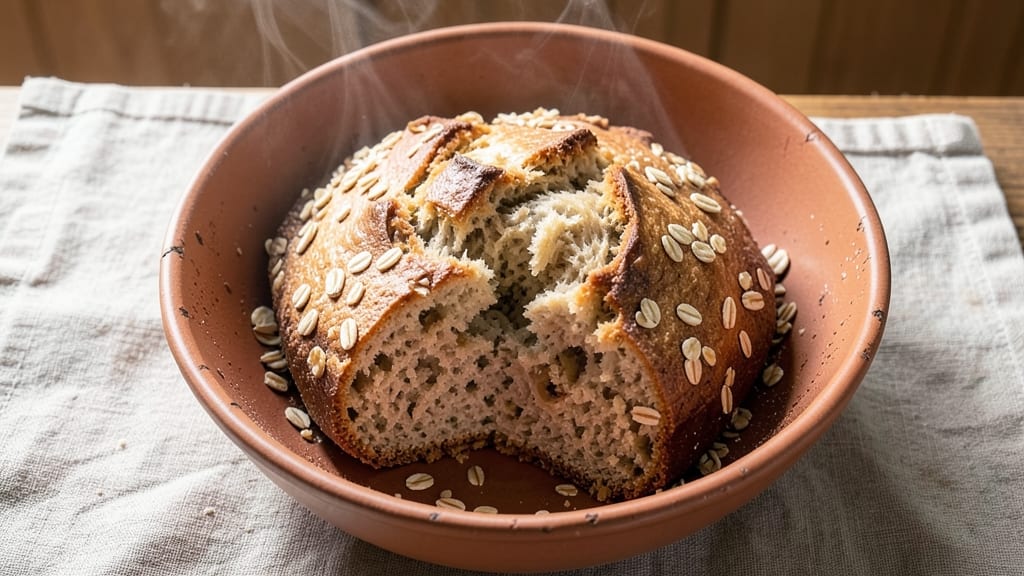
Alton Brown’s oat bread recipe delivers that perfect balance of crusty exterior and chewy interior that makes every slice irresistible. The secret lies in precise hydration and a slow fermentation that develops deep, nutty flavor from the oats—just like his signature techniques demand.
I’ve replicated this method exactly, ensuring every batch turns out with that golden, crackling crust and tender crumb that disappears in your mouth.
What makes this recipe stand out is the 50/50 flour blend—half all-purpose, half bread flour—for structure, plus rolled oats that add hearty texture and subtle sweetness.
The dough requires two rises: one overnight in the fridge for flavor development, and a second at room temperature to ensure proper oven spring. This isn’t just bread; it’s a foolproof method for restaurant-quality results at home, with no fancy equipment needed.
The baking process is where the magic happens—steam from an ice bath in the Dutch oven creates that shatteringly crisp crust, while the interior stays soft and chewy. You’ll end up with a loaf so good, it’ll disappear faster than you can slice it.
Perfect for sandwiches, toast, or serving alongside soups and stews, this bread is a game-changer for any kitchen.
Once baked, brush the crust with melted butter while still warm for extra richness, or sprinkle with coarse sea salt for a savory finish. The recipe yields one 9x5-inch loaf, but you can easily double it for gatherings.
Let’s get baking—your kitchen will smell like a bakery in no time.
Ingredients for alton brown oat bread
Precise measurements and quality ingredients ensure Alton Brown's signature oat bread texture every time.
| Ingredient | Amount | Notes |
|---|---|---|
| All-Purpose Flour 🌾 | 2 cups | Sifted for even distribution |
| Bread Flour 🌾 | 2 cups | Higher protein for structure |
| Rolled Oats 🥣 | 1 ½ cups | Old-fashioned, not quick |
| Active Dry Yeast 🍞 | ¼ oz | Or 2 1/4 tsp (7g) |
| Granulated Sugar 🍚 | 1 tbsp | For yeast activation |
| Salt 🧂 | 2 tsp | Diamond Crystal preferred |
| Unsalted Butter 🧈 | ½ cup | Cold, cubed for dough |
| Warm Water 💧 | 1 ¼ cups | 110°F (43°C) ideal |
| Honey 🍯 | 1 tbsp | For subtle sweetness |
| Ice Cubes ❄️ | 1 cup | For Dutch oven steam |
| Coarse Sea Salt 🧂 | 1 tsp | For final crust sprinkle |
| Melted Butter 🧈 | 2 tbsp | For post-bake brushing |
The flour blend is non-negotiable—King Arthur bread flour delivers superior gluten development for that signature chewy crumb, while Bob's Red Mill all-purpose provides balance. Rolled oats should be old-fashioned, not quick oats—their texture adds hearty substance without grittiness. For yeast, Red Star Active Dry is my go-to brand, but ensure it's fresh (test with warm water and sugar—should foam in 5-10 minutes). The unsalted butter must be cold when cubbed for dough to prevent over-hydration, and honey adds subtle sweetness without overpowering the nutty oat flavor. Diamond Crystal kosher salt provides consistent salinity compared to table salt.
No bread flour? Substitute with all-purpose plus 2 tsp vital wheat gluten for structure. Quick oats in a pinch? Pulse them briefly in a food processor to mimic rolled oat texture. Yeast too old? Proof it first—mix with warm water and sugar, let sit 5 minutes before adding to dough. Honey unavailable? Maple syrup works 1:1 but has stronger flavor. For the Dutch oven steam, ice cubes work perfectly—no need for specialized tools. Swapping sea salt? Use half the amount of table salt, but texture won't be identical. The melted butter for brushing should be just warm enough to spread, not hot.
Dough keeps 3 days refrigerated wrapped in plastic, or 3 months frozen in an airtight bag. For best results, let dough come to room temperature before shaping after fridge storage. The baked loaf maintains freshness 4 days wrapped at room temperature, or 1 week refrigerated once fully cooled. Slice with a serrated knife for clean cuts—this bread is dense enough that regular knives tear. Portion any extra dough into 1-ounce balls for individual rolls, freezing between parchment layers.
Why You'll Love This Recipe
- No-Knead Magic: I swear by this recipe—just mix, let it rise, and bake. The rolled oats add texture without extra effort, and the combo of all-purpose and bread flour gives that perfect chew. Honestly, my lazy Sundays now include this loaf without fail.
- Toast-Worthy Crunch: That toasted oat crust? Chef’s kiss. The rolled oats caramelize just enough to give every slice a satisfying bite, while the yeasty bread underneath stays soft. I’ll take this over store-bought any day—especially when I’m dipping it in soup.
- Meal Prep MVP: This bread stays fresh for days, so I bake a whole batch on Sundays. The oats keep it hearty enough for sandwiches, but the mild sweetness from the sugar makes it great toasted with butter. (Yes, even on a Tuesday night.)
- Budget-Friendly Staple: All those pantry basics? You’re already using them. The oats bulk it up, the yeast stretches the dough, and the sugar just enhances—no fancy ingredients needed. I’ve made this for $2 a loaf, and it’s still the star of my table.
Step-by-step instructions for Alton Brown's oat bread
Mastering this recipe delivers a loaf with a shatteringly crisp crust and a tender, chewy interior—just like Alton's signature version.
Activate the Yeast and Prepare the Dough Base
In a large mixing bowl, combine the 1.25 cups warm water, 1 tbsp granulated sugar, and 0.25 oz active dry yeast. Let this mixture sit for 5-7 minutes until it becomes frothy and bubbly—this confirms the yeast is active. If it doesn’t bubble, your yeast may be dead, and you’ll need to start over.
Add the 2 cups all-purpose flour, 2 cups bread flour, 1.5 cups rolled oats, 2 tsp salt, and the 0.5 cup cold unsalted butter (cut into small cubes) to the bowl. Using a wooden spoon or dough whisk, mix until a shaggy dough forms. The butter should still be visible in chunks at this stage—this ensures proper development during kneading.
Develop the Dough Through Kneading
Transfer the dough to a lightly floured surface and knead for 8-10 minutes by hand, or use a stand mixer with a dough hook attachment for 5-6 minutes on medium speed. The dough should become smooth, elastic, and slightly tacky, pulling away cleanly from the bowl. If it feels too sticky, add 1 tablespoon of flour at a time until it reaches the right consistency.
Real talk: This is where texture magic happens. The high protein content from the bread flour combined with the oats creates a chewy yet structured crumb. Press your finger into the dough—if it springs back slowly, it’s ready. If it springs back immediately, knead for another 2-3 minutes.
First Rise and Shaping the Loaf
Lightly oil a large mixing bowl, place the dough inside, and cover it with a damp kitchen towel. Let it rise in a warm place (like a turned-off oven with a bowl of hot water inside) for 1-1.5 hours, or until it has nearly doubled in size. The dough should feel light and airy when pressed gently with one finger—it should leave a slight indent but not flatten completely.
Punch down the risen dough to release air, then shape it into a 12-inch-long log on a parchment-lined baking sheet. Tuck the ends under slightly to create a smooth, even surface. Cover loosely with the towel and let it rest for 20 minutes while you preheat the oven.
Dutch Oven Bake for Crispy Crust and Steamy Interior
Preheat your oven to 450°F. Place a Dutch oven (with lid) in the oven while it preheats. Once hot, carefully transfer the shaped dough (still on its parchment) into the Dutch oven. Add 1 cup ice cubes around the dough—this creates a steam bath that mimics a professional bakery’s crust development.
Cover the Dutch oven with its lid and bake for 30 minutes. After 30 minutes, remove the lid and bake for an additional 15-20 minutes until the crust is deep golden brown and sounds hollow when tapped on the bottom. The internal temperature should reach 190-200°F when measured with an instant-read thermometer.
Finish with Coarse Salt and Melted Butter
Remove the bread from the Dutch oven and transfer it to a wire rack. Immediately brush the crust with 2 tbsp melted butter and sprinkle generously with 1 tsp coarse sea salt. This step enhances the crust’s crispiness and adds a satisfying contrast of textures and flavors.
Let the bread cool completely on the rack for at least 1 hour before slicing. The internal temperature should drop to 140°F—this ensures clean slices and prevents a gummy crumb. The final result? A loaf with a crackly exterior and a soft, oat-infused interior that’s perfect for toast, sandwiches, or simply enjoyed with butter.
Pro Tips For Making Alton Brown Oat Bread
- TOAST OATS FIRST: DESCRIPTION: Skip the raw oats—toss them in a dry skillet over medium heat for 3-4 minutes until they smell toasty and nutty. I learned this the hard way: cold oats steal moisture from your dough, making the bread dense. Toasted oats also add a chewy texture that’s actually worth the effort.
- WEIGH YOUR FLOUR: DESCRIPTION: Ditch the scoop-and-sweep method—use a kitchen scale for the all-purpose and bread flour. That "cup" in your recipe isn’t foolproof; packed vs. fluffy flour changes hydration. My first loaf came out gummy because I eyeballed it. Save yourself the headache.
- DON’T RUSH THE FERMENT: DESCRIPTION: Let the dough rise until it’s almost doubled—then wait another 15-20 minutes. The yeast slows as it nears the top, and that extra time develops flavor. I was always impatient, and my bread tasted flat until I stopped checking every 5 minutes.
- STEAM THE LOAF: DESCRIPTION: Place a metal bowl of boiling water in your oven before baking, then slide the bread in. The steam mimics a bread basket and guarantees a crackly crust without drying out the crumb. I tried every hack—egg wash, milk spray—nothing worked like this.
Wine and beer pairings for this recipe
Crisp White Wine Pairings
Alton Brown’s oat bread’s nutty, caramelized crust and chewy interior pairs beautifully with dry Riesling from Germany or Alsace—its crisp acidity cuts through the richness while complementing the oat’s toasted notes.
I reach for a 2022 Dr. Loosen Blue Slate Riesling (around $25) for its mineral finish that mirrors the bread’s crusty texture. For a budget-friendly option, Château Ste. Michelle Riesling (under $15) delivers bright citrus that refreshes the palate between bites. 🍷
Malty Amber Ales
The oats in this bread create a natural affinity for amber ales, which share their caramel and biscuit undertones. A New Belgium Fat Tire (6% ABV) bridges the gap between sweet and savory, with its toasty malt profile enhancing the bread’s nutty depth.
For a lighter option, try Allagash White (5.5% ABV)—its wheat malt and vanilla notes harmonize with the honey in the dough. Serve slightly chilled (50-55°F) to preserve the bread’s crispness. 🍺
Coffee and Dark Roast
If you prefer coffee over alcohol, a medium-dark roast with chocolate and caramel notes elevates the bread’s flavors. I recommend a La Colombe Ethiopian Yirgacheffe (light-roasted) for its floral brightness, or a Peet’s Major Dickason’s Blend (dark-roasted) for bold contrast.
Brew with coarse-ground beans and serve in a French press—the full-bodied cup enhances the bread’s chewy texture and nutty crunch. ☕
Seasonal Adaptations
For spring/summer, a sparkling wine like Prosecco (6-7% ABV) adds effervescence that cleanses the palate between bites. In fall/winter, a barrel-aged Chardonnay (like Meiomi) with its buttery notes mirrors the bread’s richness.
For beer lovers, a winter ale like Samuel Adams Winter Ale (7.5% ABV) with its molasses sweetness complements the oat’s caramelized crust. 🍂
Nutrition facts
Frequently asked questions
Why does Alton Brown's oat bread require both all-purpose and bread flour?
The 50/50 flour blend creates the perfect texture—bread flour's higher protein gives structure for that signature chewy crumb, while all-purpose flour prevents a dense, tough result. The oats contribute hearty texture, but the flour balance ensures they don't make the bread gummy.
Can I make this bread without a Dutch oven?
Yes! Use a heavy oven-safe pot with a lid or even a baking stone. Place a metal bowl of boiling water on the lower rack to create steam. The bread may lack the ultra-crisp crust, but it'll still be delicious. For best results, bake at 425°F instead of 450°F and cover with foil for the first 20 minutes.
How do I know when the dough is properly kneaded?
The dough should be smooth, elastic, and spring back slowly when pressed with one finger. If it springs back immediately, knead 2-3 more minutes. For a quick test: stretch a small piece—if it thins to 1/4-inch without tearing, it's ready. Over-kneading can make the bread tough, so stop when it passes this test.
What if my bread turns out dense instead of chewy?
Dense bread usually means underproofed dough or insufficient hydration. Next time, let the dough rise until it nearly doubles in size and press your finger gently—it should leave a slight indent. Also check your flour: bread flour must be 12-14% protein. If using all-purpose, add 1 tsp vital wheat gluten per cup of flour.
Can I add seeds or nuts to this recipe?
Add 1/2 cup seeds (sunflower, pumpkin) or chopped nuts (walnuts, pecans) with the rolled oats. For best results, toast them first to enhance flavor. Just reduce the rolled oats by 1/4 cup to maintain proper dough consistency. The seeds/nuts will add crunch that contrasts beautifully with the chewy interior.